
That old jar of pennies tucked in your craft room might hold more than copper for your next project. A handful of Canadian pennies are worth significant money to collectors, with the rarest specimens like the 1936 Dot Canadian Penny valued at up to $402,000 and the 1858 Canadian Large Cent at $21,000 or more. Since Canada stopped producing pennies in 2012, these coins won’t turn up in your pocket change anymore, making inherited collections, estate sale finds, and existing craft stashes the primary sources for discovering valuable pieces.
Identifying rare Canadian pennies doesn’t require expert training. You’re looking for specific dates, distinctive features like pointed versus blunt numbers, and minting errors that set certain coins apart from common circulation pieces. The 1985 cent with a pointed 5, for example, starts at about $2.50 even in circulated condition, according to PCGS grading standards. Condition matters tremendously. Professional graders use terms like “red” (95% or more of the original copper color on both sides) and “brown” to describe preservation level, and these distinctions directly impact value.
For crafters who work with pennies in jewelry, mosaics, or mixed-media projects, learning to spot valuable specimens before drilling, gluing, or patinating them protects both your collection’s worth and opens opportunities to fund more supplies. This guide walks you through the key dates and varieties to watch for, explains how to assess condition without specialized equipment, and shows you practical steps for examining coins you already own.
Why Canadian Pennies Became Collectible
The Canadian government officially discontinued the one-cent coin in 2012, citing production costs that exceeded the penny’s actual value. Once the Royal Canadian Mint stopped producing them, Canadians began pulling pennies from circulation, and businesses stopped accepting them for cash transactions. This sudden end to a familiar piece of everyday currency sparked something unexpected: a surge in collecting interest.
When an item disappears from daily use, people start viewing it through a different lens. Pennies that once jingled forgotten in desk drawers suddenly became artifacts of Canadian history. For craft enthusiasts, this shift carried particular weight. Many crafters had incorporated pennies into projects for years, pressing them into resin coasters, soldering them into jewelry, or arranging them into decorative mosaics. Now those same coins represented a finite resource with potential value beyond their copper content.
The discontinuation created two distinct collector groups. Nostalgic hobbyists began assembling date runs or saving pennies from meaningful years, treating their collections as tangible connections to childhood memories and Canadian heritage. Meanwhile, more investment-minded collectors recognized that scarcity drives value. They started examining their holdings more carefully, checking dates and varieties that might prove valuable. The Royal Canadian Mint had produced billions of pennies over more than a century, but certain years, errors, and conditions stood out as genuinely scarce.
This perfect storm, discontinuation meeting nostalgia meeting scarcity, transformed the humble penny from forgotten pocket change into something worth a second look.
The Most Valuable Rare Canadian Pennies
1936 Dot Canadian Penny
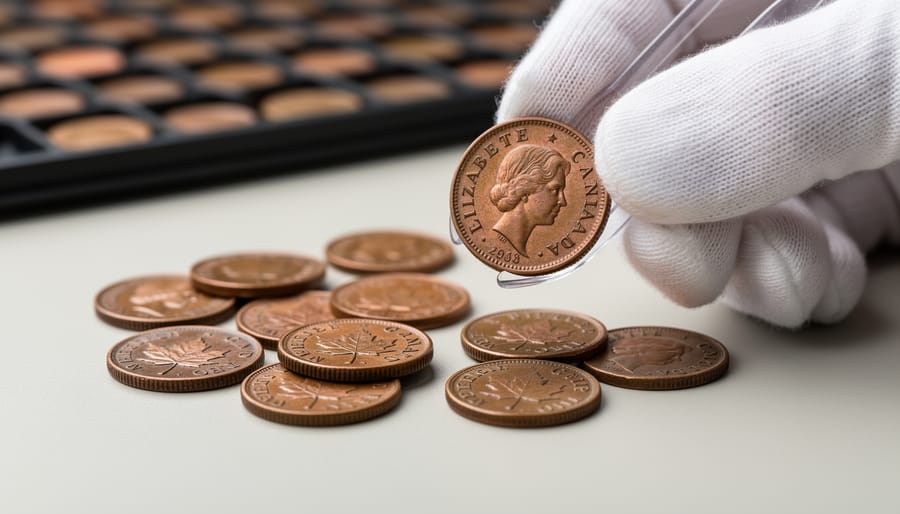
The 1936 Dot Canadian Penny stands as the holy grail of Canadian coin collecting. After King George V died in January 1936, the Royal Canadian Mint faced a dilemma: Edward VIII’s abdication happened before new dies bearing his portrait could be prepared. Rather than continue using 1936-dated dies into 1937, the Mint added a tiny dot below the date on a small number of coins to indicate they were actually struck in 1937. Only three or four genuine specimens are known to exist today.
This extreme scarcity drives the verified value up to $402,000. The dot itself is minuscule, appearing just beneath the “1936” date on the obverse (heads) side of the coin. You’d need good lighting and magnification to spot it clearly. The reality is that finding one of these pennies would be extraordinarily unlikely, as most are already accounted for in major collections or museums. If you think you’ve spotted a dot, be aware that countless counterfeits exist, and authentication by a professional grading service would be essential before getting excited about a potential windfall.
1858 Canadian Large Cent
The 1858 Canadian Large Cent represents one of the earliest Canadian coins and stands apart from later pennies in both size and historical significance. This coin measures significantly larger than the familiar small cents introduced in 1920, with a diameter of about 25.4mm compared to 19.05mm for the smaller versions. The weight difference is equally dramatic: these large cents contain substantially more copper, which contributes to their collectible appeal.
What makes the 1858 particularly notable is its place in Canadian monetary history. It was minted during the final years before Confederation, giving it both numismatic and historical value. The coin features Queen Victoria on the obverse and a simple wreath design on the reverse.
In top condition, an 1858 Large Cent can be worth up to $21,000 or more, though most examples you’ll encounter will be heavily worn and worth considerably less. The grading and color (red versus brown) dramatically affect value for these copper coins.
You might stumble across these coins in inherited collections from family members who collected coins decades ago, at estate sales, or tucked away in old coin albums purchased at antique shops. They’re not common finds in everyday penny jars since they predate most family collections by generations, but checking older accumulations is worthwhile.
1985 Pointed 5 Penny
The 1985 Pointed 5 penny stands out as one of the more accessible rare Canadian pennies for everyday collectors. That year, the Royal Canadian Mint produced pennies with two distinct varieties of the numeral 5 in the date. The pointed 5 features a sharp, angular top to the number, while the more common blunt 5 has a rounded, flat top.
This variation happened during the die-making process when the mint switched between different numeral punches partway through production. The pointed 5 variety was produced in smaller quantities, making it scarcer than its blunt counterpart.
What makes this penny particularly appealing to beginner collectors is its attainable value. Circulated examples start at about $2.50 according to PCGS, meaning you don’t need to stumble upon a museum-quality specimen to have something worth more than face value. Better-preserved examples can command higher prices, especially those graded as red (retaining 95 percent or more of the original copper color on both sides).
To identify the pointed 5, examine the date under good lighting or with a magnifying glass. Compare it to images of both varieties online. The distinction becomes obvious once you know what to look for. Check any 1985 pennies you have tucked away in old jars or inherited collections.
Other Notable Key Dates Worth Looking For
Beyond the headline rarities, several other Canadian pennies deserve attention when you’re sorting through a collection. These coins won’t command five-figure prices, but they’re still worth setting aside for further research.
The 1969 penny stands out because of a significantly lower mintage compared to surrounding years, making it scarcer in circulation. Similarly, pennies from 1982 and 1983 attract collector interest due to their lower production numbers during a period when Canada was already considering the penny’s future.
Error coins also merit a closer look. Doubled dies, off-center strikes, and planchet errors can occur in any year, and these manufacturing mistakes create unique specimens that collectors actively seek. You might spot a doubled date where the numbers appear twice slightly offset, or a penny struck on the wrong planchet that looks noticeably different in weight or color.
Early pennies from the Victorian era through the early 1900s often carry additional value simply due to age and survival rates. Lower mintages, combined with decades of circulation that removed many from existence, make these older dates worthwhile finds.
When you discover any of these coins, take time to research the specific variety and condition. Reputable coin catalogs and collector forums can help you understand what you’ve found and whether professional grading makes sense for your particular specimen.
Understanding Coin Grading and Condition
When you find a penny from 1936 or 1858 in your collection, its condition determines whether it’s worth a few dollars or potentially thousands. Professional grading provides the standardized language that collectors and dealers use to assess value.
Grading evaluates two main aspects: the coin’s physical wear and, for copper pennies, its color preservation. A penny that’s barely circulated will always command higher prices than one that’s been handled for decades, but color adds another crucial dimension to Canadian pennies made from copper.
The color designations matter enormously for these coins. A penny graded ‘red’ must have that original copper color over at least 95 percent of its surface on both sides. These specimens have avoided the oxidation that naturally darkens copper over time, and they’re the most sought-after by serious collectors. A coin graded ‘brown’ will be brown over the same area, showing the patina that develops as copper ages. Between these two extremes, you’ll find coins graded ‘red-brown’ that show a mix of both colors.
Think of it this way: two 1985 pointed 5 pennies might both show minimal wear, but if one retained its original red luster while the other has turned completely brown, the red example could be worth several times more. Even though circulated 1985 Canada cents with a pointed 5 start at about $2.50 according to PCGS, that baseline shifts dramatically based on color grade.
PCGS is one of the independent professional grading services that evaluates coins and encapsulates them in protective holders with the assigned grade. Getting a potentially valuable penny professionally graded costs money upfront, but it provides authentication and a universally recognized condition assessment that serious buyers trust.
How to Identify Rare Canadian Pennies in Your Collection
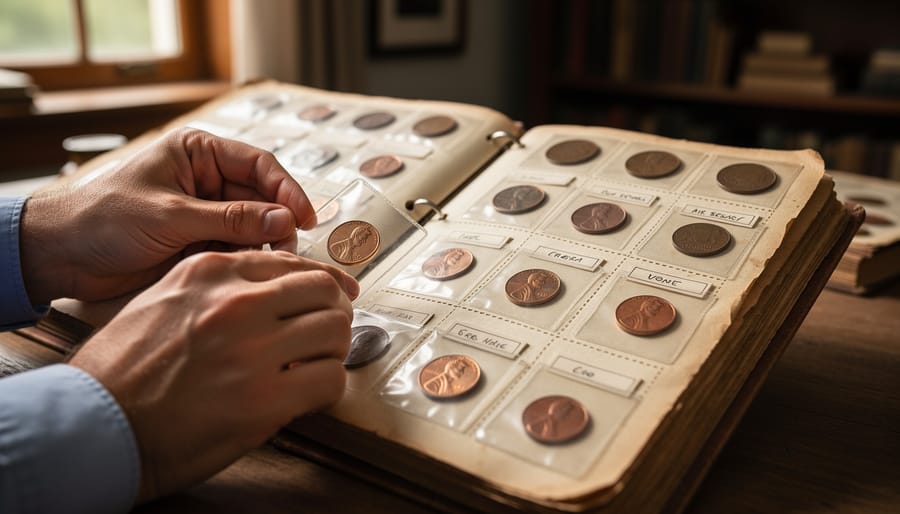
Grab a handful of pennies from your collection and let’s turn this into a mini treasure hunt. You don’t need fancy equipment to start, just good light, a magnifying glass, and a systematic approach that keeps the process enjoyable rather than overwhelming.
Start by sorting your pennies into decade groups. This simple organization step makes it easier to spot patterns and focus your attention on the most promising candidates. Once sorted, you can work through each group methodically.
- Sort by date and organize chronologically. Separate pennies by decade, then arrange them in date order within each group. This makes it easier to spot gaps or duplicates and helps you focus on specific years worth examining closely.
- Check for historically significant dates. Pull out any pennies from 1936, 1858, or 1985 for closer inspection. These dates have known valuable varieties, though finding them is rare. Also set aside pennies from years with lower mintages or special historical context.
- Examine varieties using magnification. For coins like the 1985 penny, use a magnifying glass to compare the shape of the “5” in the date. Look at the top of the number, a pointed 5 has a sharp triangular top, while a blunt 5 has a rounded, flattened top. Check reference images online to see the difference clearly before making judgments.
- Look for minting errors and anomalies. Inspect each penny for doubled images (especially visible in letters or numbers), off-center strikes, or unusual marks that occurred during production. Errors can include wrong planchets (coin blanks), missing details, or extra metal. Use bright, angled light to reveal subtle doubling.
- Assess the condition honestly. Note whether the penny retains its original red copper color or has turned brown with age. Check for wear on the high points, the Queen’s cheek or the maple leaves. Coins that look barely circulated are worth researching further, especially if they’re from a key date.
- Research your specific finds using reputable sources. Once you’ve identified potential candidates, consult PCGS guides, numismatic websites, or Canadian coin reference books. Compare your coin’s characteristics against verified examples rather than relying on a single source or forum post.
Keep a simple notebook or spreadsheet to track what you’ve examined. Note the date, condition, and any interesting features. This record helps you avoid re-checking the same coins and builds your knowledge over time.
The best lighting setup is natural daylight near a window, supplemented with a desk lamp you can angle. Harsh overhead light creates shadows that hide details, while soft, directional light reveals the coin’s surface features. A basic jeweler’s loupe (10x magnification) costs under ten dollars and reveals details your naked eye will miss.
Don’t rush the process. Examining twenty pennies carefully teaches you more than speed-sorting hundreds. You’ll start recognizing normal wear patterns, typical color variations, and what actually looks unusual versus what’s just age-related change.
Where to Find Rare Canadian Pennies
Start your search at home. Many valuable Canadian pennies hide in plain sight, tucked away in old coin jars, dresser drawers, or forgotten cigar boxes in the attic. Check any inherited collections first, especially from grandparents or older relatives who lived through Canada’s penny-producing decades. Since pennies circulated until 2012, you might find decades worth of accumulated coins in household change containers.
Estate sales and garage sales offer excellent hunting grounds. Sellers often price coin collections by weight or face value without checking for rare dates or varieties. Arrive early and ask specifically if they have any old Canadian coins. Many families liquidating estates simply want to clear out items quickly.
Visit local antique shops and flea markets, where dealers sometimes purchase entire coin collections without examining individual pieces. Browse any bins of loose coins, and don’t overlook mixed lots of foreign currency. Crafters who frequent these venues for supplies can easily add coin hunting to their regular rounds.
Coin shows and local numismatic club meetings connect you with knowledgeable collectors who can help identify what you’ve found. Check community bulletin boards or online event listings for shows in your area. These events often feature dealers selling coins at various price points, and many collectors enjoy sharing expertise with newcomers.
Bank rolls remain worth checking if you find a willing branch, though most Canadian banks have cycled out penny inventory since the 2012 discontinuation. Credit unions and smaller community banks might still have customer deposits of rolled pennies waiting to be sorted.
What to Do When You Find a Potentially Rare Penny
Finding a penny that looks promising is exciting, but take a moment before you celebrate. First, handle it carefully, hold it by the edges to avoid adding fingerprints or oils that can affect its condition. Don’t clean it; collectors actually prefer the natural patina, and scrubbing can drastically reduce value.
Start with basic research using reputable coin collecting websites or reference books to confirm the date, variety, and any distinguishing features. Compare your coin to verified examples online, paying close attention to details like the pointed versus blunt 5 on 1985 pennies. Just as you’d carefully remove old photos from albums to preserve them, treat potentially valuable coins with similar respect.
If your research suggests you have something special, say, a 1936 with a dot or a high-grade early large cent, consider professional grading through PCGS. Grading costs money, so it’s worth it only when the coin’s potential value justifies the expense.
Here’s the reality check: most pennies you find, even older ones, will be worth face value or slightly more. But that’s okay. The thrill is in the hunt, learning about Canadian history, and occasionally discovering a gem. Even if you never find a $402,000 coin, you’ll have developed an eye for detail and a deeper appreciation for what’s hiding in plain sight.
Using Canadian Pennies in Craft Projects
Before you glue, drill, or polish those pennies for your next craft project, take a few minutes to sort through them. Most Canadian pennies from your jar are perfect for crafting, they’re discontinued currency with minimal value, but you could accidentally destroy a specimen worth considerably more than one cent if you skip this step.
Common pennies work beautifully for penny floors, where you arrange and seal them under epoxy for a stunning metallic surface. They’re also popular in jewelry making (flattened and stamped into pendants), mosaic art, and decorative backsplashes. The copper patina adds warmth to mixed-media pieces and scrapbook embellishments.
Set aside any pennies from before 1970, coins with unusual characteristics (dots, doubled images, off-center strikes), and those in exceptional condition before you start crafting. Check dates like 1985 for the pointed 5 variety, which is worth holding rather than hammering flat. Keep a small reference list of key dates handy in your craft room, it takes seconds to check and could save you from turning a collectible into a keychain.
For your projects, focus on the abundant common dates from the 1980s through 2012. You’ll have plenty of material for your creative vision while preserving anything that might be significant. The best part? Knowing what you’re working with makes the craft more intentional and informed.
Common Questions About Rare Canadian Pennies
Should I clean my old pennies?
No, never clean coins you think might be valuable. Cleaning removes the natural patina and can dramatically reduce a coin’s grade and value. Professional collectors and graders prefer coins in their original state, even if that means they look tarnished or dirty.
Where can I get my coins professionally graded?
PCGS is an independent professional coin grading service that can authenticate and grade your coins. They’ll assess the condition and assign a grade, which is essential for establishing value on potentially rare specimens. Professional grading does come with fees, so it’s worth researching whether your coin justifies the cost before submitting.
Are all old Canadian pennies valuable?
Most old Canadian pennies are worth only face value or slightly more to a general collector. The truly valuable ones are rare because of extremely low mintages, historical significance like the 1936 Dot, or specific varieties like the 1985 Pointed 5.
How do I sell rare pennies I’ve found?
You can sell through reputable coin dealers, auction houses specializing in numismatics, or established online marketplaces for collectors. Getting coins professionally graded first establishes credibility and often results in better prices, especially for higher-value specimens.
These questions come up constantly in collecting circles, and knowing the answers saves you from common mistakes. The cleaning question is especially important because it’s tempting to make an old coin look shiny, but you’ll destroy its collector value in the process. The brown or red grading mentioned earlier reflects the coin’s natural aging, and professionals want to see that authentic patina.
If you’re incorporating pennies into craft projects, understanding value helps you make smart choices. Common pennies work beautifully for projects involving types of papersusing adhesive and other scrapbooking supplies but you’ll want to set aside any potentially rare specimens before starting your creative work. Check dates and varieties first, then craft with confidence knowing you haven’t accidentally embedded a valuable coin in your art.
Now that you’ve learned which rare Canadian pennies exist and how to spot them, it’s time to dig through your old coin jars and inherited collections. The truth is, most pennies won’t make you rich, odds are slim you’ll find that $402,000 1936 Dot penny hiding in your dresser drawer. But that’s not really the point.
The real reward comes from the hunt itself. Examining dates under magnification, learning to distinguish pointed from blunt numerals, understanding why certain varieties exist, these are the moments when history comes alive. Each penny tells a story about Canadian manufacturing, economic policy, and the everyday transactions of previous generations. You’ll develop a sharper eye for detail, patience for research, and appreciation for the craft of coin production.
Whether you decide to keep a few key dates aside or use common pennies in your next mosaic project, you’re now part of a community that values both historical preservation and creative expression. Check your pennies before you craft with them, handle potential rarities with care, and enjoy the process. The knowledge you’ve gained transforms what could’ve been pocket change into a fascinating connection with Canada’s numismatic heritage.