
Corner clamps hold two pieces of wood at a perfect 90-degree angle while glue dries or screws set, solving one of the trickiest challenges in woodworking: keeping joints square without a third hand. If you’re building picture frames, boxes, cabinets, or shelving, these tools eliminate the wobble and frustration of trying to balance everything at once.
The right corner clamp transforms assembly from a sweaty juggling act into a calm, precise process. You’ll find options ranging from budget-friendly plastic sets under $25 to heavy-duty cast aluminum models that handle larger projects. Most woodworkers keep several sizes on hand because different joints demand different clamping pressures and reach.
Right now, multi-pack sets dominate the market because they let you clamp all four corners of a frame simultaneously. The VEXTHYX 4-pack leads Amazon’s bestsellers at $29.99 with a 4.4-star rating, while the WETOLS set sits at $23.99 with over 3,800 reviews. For serious projects, the 8-piece combo set offers both 5.5-inch and 3.14-inch sizes in a storage box for $59.99, earning a 4.6-star rating.
The difference between a clean, professional-looking joint and a gappy mess often comes down to choosing clamps that match your project scale and applying even pressure. I’ll walk you through the key factors that separate frustrating clamps from reliable ones, compare the main types you’ll encounter, and help you avoid the common mistakes that lead buyers to regret their purchase.
What Corner Clamps Do (And Why You Need Them)
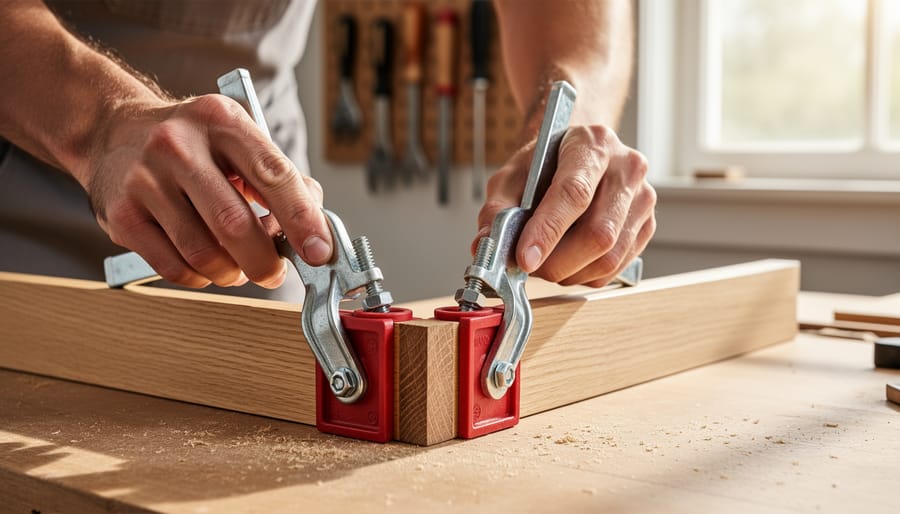
Corner clamps are specialized woodworking tools designed to hold two pieces of wood at a precise 90-degree angle while you assemble and glue them together. Think of them as an extra pair of hands that never get tired, keeping your workpieces perfectly square while you drill, screw, or wait for adhesive to dry. Without them, you’re left juggling multiple pieces, trying to keep everything aligned while simultaneously trying to use the right adhesive or fasten joints, which often results in frustratingly crooked corners.
These clamps shine in a wide range of woodworking projects. Picture frames are perhaps the most obvious application, where even a slight misalignment ruins the professional look you’re after. They’re equally valuable when building boxes, drawer assemblies, cabinets, and furniture pieces like bookcases or side tables. Any project requiring clean right angles benefits from the consistent pressure and positioning corner clamps provide.
The beauty of corner clamps lies in how they solve a problem every woodworker faces: achieving tight, square joints without the awkward dance of holding, checking, adjusting, and somehow still having a free hand to secure everything. They bring stability and accuracy to your workflow, letting you focus on craftsmanship rather than gymnastics.
Types of Corner Clamps Compared
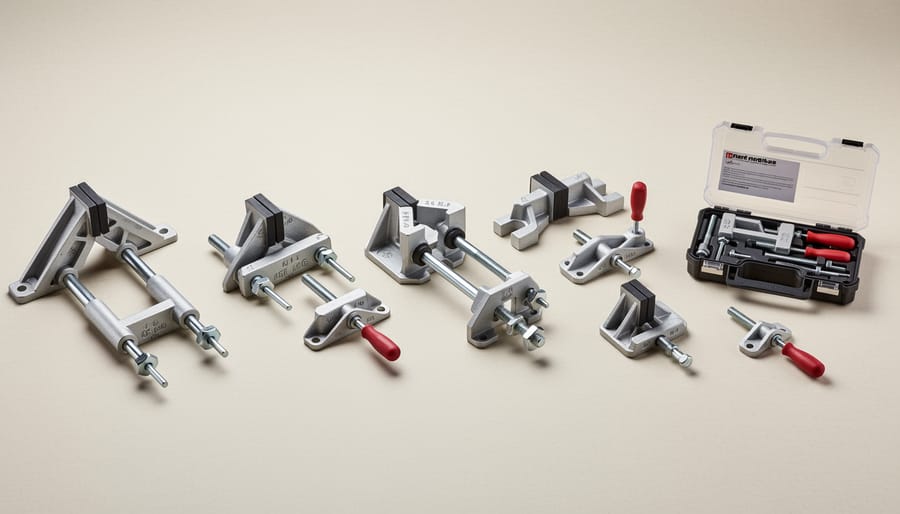
Single-Corner Clamps
Single-corner clamps are the workhorses of right-angle woodworking, simple, reliable tools that hold one 90-degree joint at a time while you drill, glue, or fasten. They’re perfect for lighter projects like picture frames, small boxes, or drawer assemblies where you’re working corner by corner rather than clamping an entire structure at once.
These clamps typically feature two perpendicular jaws that press against the inside or outside faces of your workpieces, maintaining that crucial right angle while the glue sets. You’ll find two main varieties: fixed models that lock at exactly 90 degrees, and adjustable versions with screw mechanisms that let you fine-tune the pressure and accommodate slight variations in material thickness. Fixed clamps tend to be faster to position, while adjustable models give you more control, especially helpful when working with softer woods that dent easily under too much pressure.
For beginners just getting started with woodworking, single-corner clamps make an excellent entry point. They’re straightforward to use, generally affordable, and teach you proper clamping technique without the complexity of multi-corner systems. As your projects grow in scale, you can always add more units or graduate to corner clamp sets that handle multiple joints simultaneously.
Multi-Angle Clamps
Multi-angle clamps expand your woodworking possibilities beyond the standard right angle. These versatile tools typically offer preset positions at 60, 90, and 120 degrees, making them essential for projects like hexagonal frames, octagonal mirrors, angled shelving, and decorative trim work. If you’ve ever struggled to hold mitered corners at odd angles while the glue sets, you’ll appreciate what these clamps bring to your workshop.
The key advantage is flexibility. Instead of buying separate specialized clamps for each angle you might encounter, one multi-angle clamp adapts to various configurations. Many models feature indexed angle stops with clear markings, so you can quickly set your desired position and trust it’ll hold accurately throughout assembly. Some higher-end versions offer fully adjustable angle ranges rather than fixed presets, giving you even more creative freedom for custom angles.
When evaluating multi-angle clamps, check how securely the angle mechanism locks. A loose or imprecise adjustment defeats the purpose. Look for positive detents or locking levers that prevent the angle from shifting under clamping pressure. These clamps generally cost more than basic 90-degree versions, but the versatility justifies the investment if you regularly tackle projects with varied angles.
Corner Clamp Sets
Corner clamp sets have become the go-to choice for most woodworkers, and it’s easy to see why. When you’re assembling a picture frame, cabinet door, or any box project, you need all four corners clamped at once, not one at a time. Trying to glue up a square project with just a single clamp means constantly repositioning and waiting, which often leads to frustration and misaligned joints as the glue starts to set.
Sets typically come in 4-packs or 8-packs, with 4-packs being the most popular configuration since they handle one complete frame or box in a single glue-up. The 8-pack options give you the flexibility to work on two projects simultaneously or tackle larger assemblies that need extra holding power at multiple points. Current best-sellers on Amazon reflect this preference: the top three angle clamps are all multi-packs, ranging from 4-piece sets to combination 8-piece kits that include different clamp sizes for various project scales.
| Clamp Type | Best Use Case | Typical Project Size | Skill Level |
|---|---|---|---|
| Single-Corner Clamps | Small repairs, one-off angles | Individual corners, craft projects | All levels |
| Multi-Angle Clamps | Non-square projects, specialty work | Hexagonal frames, angled assemblies | Intermediate to advanced |
| Corner Clamp Sets | Frames, boxes, cabinets | Complete assemblies requiring simultaneous clamping | All levels |
The cost-per-unit savings with sets are substantial. Rather than paying full price for individual clamps, you’ll usually save 20 to 30 percent per clamp when buying a set. Plus, most sets come with dedicated storage cases or organizing trays, keeping all your clamps together and preventing the common workshop problem of misplaced hardware. The convenience factor alone makes sets worthwhile, grabbing one case gives you everything you need for a complete project rather than hunting through drawers for matching clamps.
Key Factors When Choosing Corner Clamps
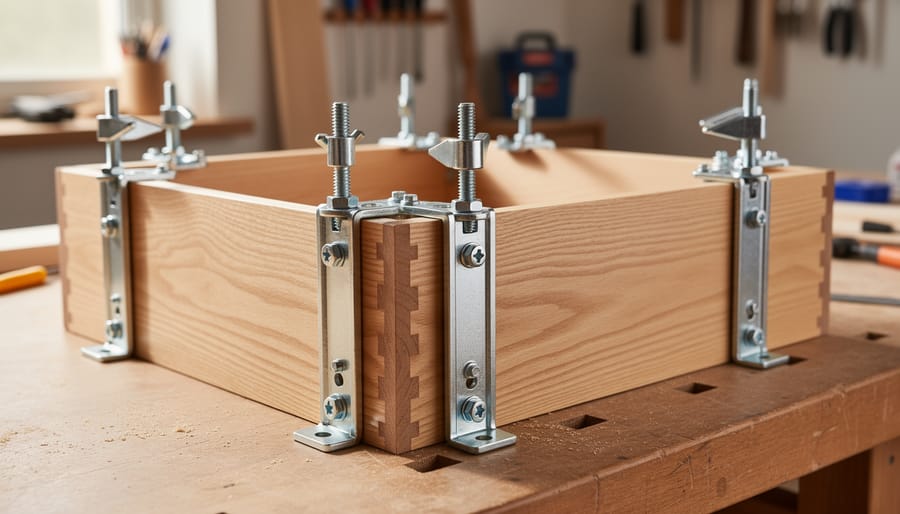
Clamping Capacity and Opening Size
Clamping capacity determines what size materials your corner clamps can handle, and getting this wrong means you’ll end up with tools that don’t fit your stock. The maximum opening size refers to how wide the clamp jaws can spread, typically ranging from around 1.5 inches for compact models up to 3 inches or more for larger clamps. This measurement dictates the thickness of boards or panels you can secure at the corners.
Think about your typical projects before buying. If you’re building picture frames from 3/4-inch molding, a smaller capacity works fine. But cabinet work or furniture assembly with thicker stock requires clamps with wider openings. Some models also specify maximum workpiece thickness separately from jaw opening, so check both specs.
Consider that you’ll often clamp materials at their thickest point, not their thinnest. A box made from 1-inch boards needs clamps that accommodate at least that thickness, plus a bit of clearance for adjustment. Many popular clamp sets accommodate material up to around 2 inches, which covers most DIY woodworking projects. Undersized clamps won’t grip properly, creating wobbly joints and frustration during glue-up. Measure your lumber dimensions first, then choose clamps with capacity to spare.
Material and Durability
The material your corner clamps are made from directly affects how much pressure they can apply and how long they’ll last through repeated use. Most models use one of three materials: aluminum, steel, or plastic.
Aluminum clamps offer a sweet spot between strength and weight. They resist rust, apply solid clamping pressure, and won’t fatigue your hands during extended sessions. These are common in mid-to-higher-tier models and handle regular woodworking tasks well.
Steel clamps deliver maximum strength and clamping force, making them ideal for thick hardwoods or projects requiring serious pressure. They’re heavier and may rust if not properly cared for, but they’re built to last decades with basic maintenance.
Plastic or composite clamps are lightweight and affordable, perfect for light-duty work like picture frames or small craft projects. They won’t exert the same force as metal options and can crack or warp over time under heavy use.
Beyond material alone, check build quality carefully. Look for smooth threads, sturdy joints, and consistent machining, sloppy construction leads to wobbling and uneven pressure. User reviews are invaluable here. Models with thousands of ratings give you reliable feedback on real-world durability. A clamp rated 4.3 stars from nearly 4,000 reviews, for example, has proven itself across countless workshops and projects.
Ease of Use and Adjustment
When you’re working on a woodworking project, the last thing you want is to wrestle with complicated clamps. Look for corner clamps with quick-release mechanisms that let you adjust and position them in seconds rather than fumbling with screws and knobs. Ergonomic handles make a real difference during long assembly sessions, reducing hand fatigue when you need to apply consistent pressure across multiple corners.
Clear angle markings are surprisingly helpful, especially if you’re working with multi-angle clamps. You should be able to see at a glance whether you’re set at 90 degrees without second-guessing yourself mid-assembly. The best clamps feature easy-to-read engravings or printed scales that won’t wear off after a few uses.
Pay attention to how smoothly the adjustment mechanisms operate. Quality clamps tighten evenly without binding or requiring excessive force. Read through user reviews to see if other woodworkers mention sticky adjustments or stripped threads, which are common complaints with poorly designed models.
For beginners, ease of use matters even more. You’re already learning proper joinery techniques and managing glue-up timing. Your clamps should simplify the process, not add another layer of complexity. Models with intuitive designs help you focus on the craftsmanship rather than fighting your tools.
Versatility in Angles and Applications
Most corner clamps lock you into 90-degree angles, which works perfectly for picture frames, boxes, and cabinets, the bread and butter of woodworking. But if your projects venture beyond standard rectangles, you’ll want clamps that adjust to multiple angles. Some models offer preset stops at 60, 90, and 120 degrees, letting you tackle hexagonal boxes, angled shelving, or mitered furniture legs without fighting the tool.
Check whether a clamp’s jaws accommodate different material thicknesses and widths. A clamp that handles stock up to 1.5 inches thick and accepts various auxiliary fence widths gives you flexibility across projects, joining thin plywood one day, hardwood table legs the next. If you’re building exclusively square assemblies, a basic 90-degree set does the job. But woodworkers who experiment with angles or work with non-standard stock dimensions will find multi-angle, adjustable-capacity clamps worth the modest price bump.
Price and Value for Money
Corner clamps range from around $20 for a basic 4-pack set to $60 or more for premium models with additional sizes or features. Sets almost always deliver better value than buying individual clamps, since most woodworking projects require clamping multiple corners simultaneously. When evaluating whether a clamp justifies its price, examine the construction material, clamping capacity, and user feedback alongside the cost.
For example, a mid-range set with thousands of verified reviews and a 4.3-star rating typically signals a dependable choice, while a cheaper option with minimal feedback carries more risk. Don’t automatically assume the lowest price means the best deal. Consider how the clamp’s features align with your typical projects and whether it includes the accessories you need, from carrying cases to multiple angle settings. Investing in quality clamps from reputable best woodworking supplies sources saves frustration and delivers consistent results across years of use.
Top Corner Clamp Recommendations for Different Needs
Finding the right corner clamp depends on your project style and skill level. Here’s a breakdown of stand-out options that serve different woodworking needs.
For Beginners: WETOLS 90 Degree Corner Clamp Set
If you’re new to woodworking, the WETOLS 4-piece set earns its spot as one of the beginner tested picks for good reason. With 3,840 reviews and a 4.3-star rating, it’s been proven by thousands of users. The adjustable design accommodates various material thicknesses, and the straightforward tightening mechanism won’t overwhelm someone just starting out. A four-pack gives you enough clamps to secure an entire frame at once, which matters more than many beginners realize.
For Value: VEXTHYX 4-Pack Corner Clamps
The VEXTHYX set sits at the top of Amazon’s angle clamp best-sellers list, combining quality with practicality. Its 4.4-star rating from 180 reviews reflects consistent performance across everyday woodworking tasks. This set handles standard right-angle positioning reliably, and having four clamps means you can work on boxes and frames without waiting for glue to set before repositioning. It strikes a solid balance between cost and capability.
For Precision and Versatility: 8-Piece Mixed-Size Set
When your projects vary in scale, small jewelry boxes one week, larger cabinet frames the next, an 8-piece set with two size options delivers flexibility. The third-ranked Amazon best-seller includes four 5.5-inch and four 3.14-inch clamps, letting you match clamp size to project dimensions. At 4.6 stars from 118 reviews, users appreciate the ability to avoid damaging materials by selecting the appropriate clamp capacity. The included storage box keeps the set organized.
Quick Reference Guide:
- Best for beginners: WETOLS adjustable 4-pack with proven user track record
- Best value set: VEXTHYX 4-pack for reliable right-angle work
- Best for precision work: 8-piece mixed-size set with storage case
- Best versatility: Sets offering multiple angle settings beyond 90 degrees
These recommendations reflect current market leaders based on verified best-seller rankings and user feedback. Start by identifying your most common project size and whether you need multi-angle capability. A quality 4-pack handles most DIY woodworking scenarios, while larger or varied sets suit workshops with diverse project demands.
Mistakes to Avoid When Buying Corner Clamps
Choosing Clamps Too Small for Your Projects
One of the most frustrating mistakes is buying clamps that look sturdy but simply can’t accommodate your materials. Before you click “buy,” grab a tape measure and check your typical stock dimensions, both thickness and width. If you regularly work with 2-inch-thick lumber or wide panel glue-ups, a clamp rated for a 1.5-inch maximum opening will leave you stuck. Many beginner-friendly models work beautifully for thin plywood frames and small craft projects, but they won’t handle heavy-duty furniture builds. Don’t guess at compatibility based on product photos alone. Read the specs carefully, compare them against your actual project measurements, and look for clamps with at least a half-inch of capacity beyond what you think you’ll need, your future projects will thank you.
Ignoring User Reviews and Ratings
User reviews and ratings are one of your most reliable tools for separating quality clamps from disappointing ones. A product with thousands of reviews, like some popular models with over 3,000 ratings, tells you it’s been tested in real workshops by countless woodworkers. Those numbers represent actual experience with clamping pressure, durability, and whether the clamp stays square under stress.
Pay attention to both the star rating and the review count. A 4.5-star clamp with only twenty reviews is less proven than a 4.3-star model with thousands. Read through recent critical reviews to spot recurring issues: stripped threads, weak pressure, or clamps that don’t hold angles accurately. These patterns reveal problems you won’t find in product descriptions. Spending five minutes reading reviews can save you from buying clamps that look great in photos but fail when you need them most.
Buying Only One Clamp Instead of a Set
It’s tempting to buy just one corner clamp to test the waters or save money upfront, but this approach backfires quickly in actual woodworking. Most projects, picture frames, boxes, cabinets, shelving units, have at least four corners that need simultaneous clamping. If you only own one clamp, you’ll glue and clamp one corner, wait for it to dry, then move to the next. This piecemeal process introduces alignment errors and wastes hours of shop time.
Sets solve this. A 4-pack lets you secure an entire frame at once, ensuring all corners stay square while the glue sets. Many woodworkers find that 4-packs become their baseline, with 8-packs offering extra flexibility for larger assemblies or multiple projects running in parallel. The cost-per-clamp drops significantly when buying in sets, and you avoid the frustration of discovering mid-project that you’re three clamps short. Start with at least four, your future self will thank you when that jewelry box goes together perfectly on the first try.
Frequently Asked Questions
What size corner clamps do I need?
Measure the thickness and width of your stock material first. Most corner clamps handle materials up to 1.5 inches thick, but check the maximum opening specifications before buying to ensure they’ll accommodate your typical project dimensions.
Can corner clamps be used for angles other than 90 degrees?
Yes, multi-angle clamps offer settings beyond 90 degrees, typically including 60 and 120 degrees for hexagonal or angled projects. Standard single-corner clamps are fixed at 90 degrees, so choose multi-angle models if you need versatility.
How many corner clamps should I buy?
Most woodworking projects require clamping all corners simultaneously during assembly, so a 4-pack is the practical minimum for frames and boxes. An 8-pack gives you flexibility for larger projects or allows you to work on multiple assemblies at once.
Are expensive corner clamps worth it?
Not always. User reviews reveal that mid-priced models like the WETOLS set with 3,840 reviews at 4.3 stars often perform just as reliably as premium options. Focus on build quality, clamping capacity, and verified ratings rather than price alone when deciding.
If you’re just getting into woodworking and assembling a starter toolkit beginning with a quality 4-pack corner clamp set gives you everything needed for most basic framing and box projects without overbuying. You can always add specialized multi-angle clamps or additional sets as your skills and project complexity grow. The key is matching your first purchase to the projects you’ll actually tackle in the near term, not trying to cover every possible future scenario.
Choosing the right corner clamps comes down to understanding your project needs and investing in tools that will grow with your skills. Focus on clamping capacity that matches your material dimensions, durable construction that can handle repeated use, and user-friendly features that make setup quick and frustration-free. A quality 4-pack or 8-pack set gives you the flexibility to tackle frames, boxes, and cabinets without constantly repositioning a single clamp, and the cost-per-unit savings make sets a smart starting point.
You now have the knowledge to evaluate models confidently, spot common pitfalls, and choose clamps that will serve you well for years. Start with a well-reviewed set that fits your typical project scale, and you’ll wonder how you ever managed square corners without them.